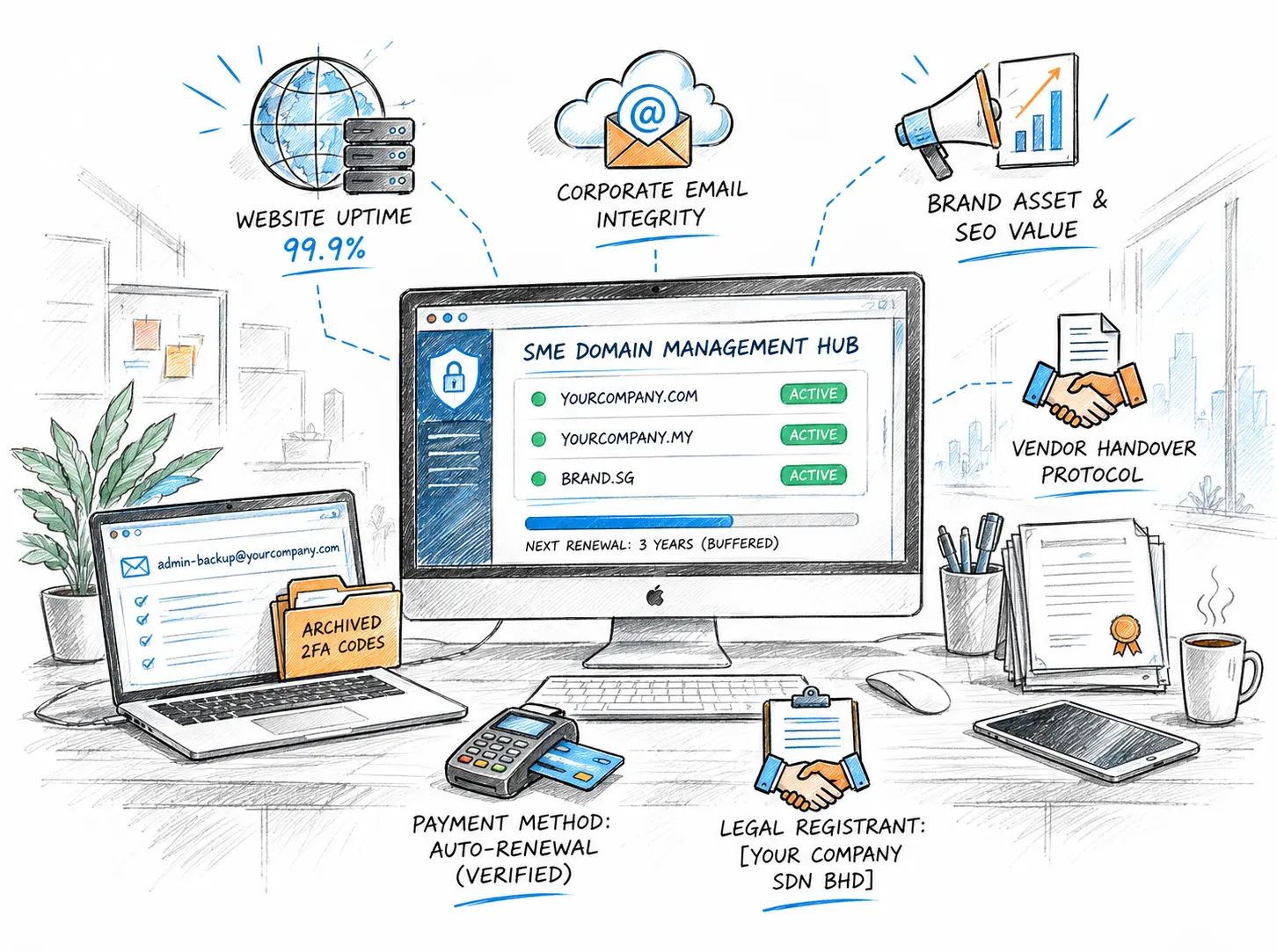
A growing business might invest tens of thousands of ringgit every year into brand building, corporate email suites, web development, and digital advertising.
Yet, while advising business leaders on digital strategy, I often notice a curious blind spot: a foundational technical asset costing merely tens to hundreds of ringgit annually to maintain is frequently overlooked by executive management.
That asset is the company’s domain name.
When asked about their domain names, founders and managers of small and medium-sized enterprises (SMEs) with 5 to 20 employees often give familiar answers: “I think the web designer we hired a few years ago bought it for us?” “It’s tied to my personal credit card, so it should auto-renew every year, right?” “Isn’t that something the technical guys take care of?”*
For small businesses operating without full-time IT personnel, this mindset is both understandable and common. Business owners are naturally focused on cash flow, client acquisition, and day-to-day operations; deep-diving into technical nuances is rarely top of mind.
However, while the acquisition cost of a domain name is negligible, the daily business operations riding on it far exceed its invoice value.
When domain governance lapses, the fallout extends far beyond an inaccessible URL—it disrupts your business continuity.
1. Reframing the Perspective: A Domain Name Is a Business Anchor, Not an IT Utility
Many business owners treat domain names as a minor administrative expense, much like office broadband or printer paper. From a digital asset perspective, however, a domain name fulfills two vital roles:
- The Critical Nerve Center for Core Business Systems Your official website, corporate email infrastructure, customer-facing portals, and ad landing pages depend entirely on your domain and its underlying DNS configuration. When the primary domain experiences downtime or misconfiguration, it paralyses client communication and digital operations alike.
- An Essential Intangible Brand Asset According to regulatory frameworks established by ICANN (Internet Corporation for Assigned Names and Numbers) and national registries such as MYNIC (responsible for
.mydomains in Malaysia), a domain name represents the legitimate right of use and administrative authority granted to an organization during a registered term. Over time, search engine optimization (SEO) equity, branded search authority, and customer trust accumulate under that address. It acts as both your digital address and your trademark online.
Behind an inexpensive annual fee lies the operational bedrock of your enterprise.
2. Four Common Domain Risks for SMEs Under 20 Employees
In businesses without dedicated IT departments, domain disruptions rarely stem from sophisticated cyberattacks. Instead, they occur due to an absence of long-term operational ownership. Here are four common real-world scenarios:
1. Orphaned Accounts: Lost Registrars and Departed Personnel
2. Payment Failures and Ignored Expiration Notices (Lifecycle Realities)
3. Vendor Disruption and Incomplete Asset Handover
4. Ambiguous Ownership Entities (Registrant Flaws)
3. Four Pillars of SME Domain Governance
Small businesses do not need bureaucratic corporate approval workflows, but they do require clear operational boundaries. I recommend structuring governance around four core pillars:
Ownership
Register the domain under your legal business entity.
Control
Retain account access, 2FA and recovery codes.
Continuity
Maintain independent recovery contacts and renewal oversight.
Accountability
Assign responsibility for DNS changes and handovers.
- Ownership: Verify that WHOIS or registry records explicitly list your company’s legal entity as the primary Registrant.
- Control: Retain master administrative credentials, primary authentication, and recovery documentation so your company can smoothly manage or transfer the domain during personnel shifts or vendor transitions. Enable Two-Factor Authentication (2FA) and securely store offline 2FA Recovery Codes. If an employee whose mobile device holds the authenticator leaves or loses their phone, an account without backup codes can become permanently inaccessible.
- Continuity: Ensure domain administrative notices are routed through monitored, permanent company channels with secondary contacts in place. Crucially, avoid the common trap of using an email address that depends on the domain itself (e.g.,
[email protected]) as your sole account recovery contact. If DNS resolution fails or the domain lapses, that mailbox goes down with it, leaving you unable to receive password reset links or authorization codes. For mission-critical domains, configure an independent, company-controlled external backup email address, and renew registrations in 3- to 5-year blocks to avoid annual renewal slip-ups. - Accountability: Clearly designate who is authorized to adjust DNS configurations and verify ongoing service integrity.
A Common Small-Business Scenario
Consider this typical scenario:
A company with 12 employees hires a freelance web designer to launch their website five years ago. The designer sets up the domain, web hosting, and corporate email. Every year, the founder receives an invoice from the designer and passes it to finance for payment. Fast-forward a few years: the business has grown and decides to partner with an established agency to overhaul its digital infrastructure. However, when preparing to deploy the new platform, the team discovers that nobody knows which registrar holds the domain, nor who controls master DNS access. The original freelance designer has switched careers and is unreachable. Regardless of how well-designed the new website is, the team cannot launch. On the surface, this looks like a technical hiccup. In reality, the issue isn’t web design; it is the absence of formal asset ownership and handover protocols from day one.
When engaging external service providers, businesses must balance immediate project deliverables with long-term operational continuity and underlying asset ownership.
4. How Should Companies Without an IT Department Organize Domain Management?
For a business with 5 to 20 staff, hiring a full-time systems engineer simply to oversee a handful of domains makes little financial sense.
Should an SME manage its domains internally, or hand them over entirely to an external agency?
It is not an either-or decision. The goal is to adopt a management model tailored to your internal technical capacity:
| Management Model | Operational Structure | Best Suited For |
|---|---|---|
| Model A: In-House Management | Founders or key executives directly create and maintain the registrar account, linking company cards, independent recovery emails, and corporate security credentials. | Teams with basic technical literacy and the discipline to regularly audit digital assets and secure 2FA credentials. |
| Model B: Managed Agency Retainer | A reputable digital agency oversees renewals, monitors DNS health, and provides technical escalations. | Busy management teams without technical backgrounds who need dedicated external oversight and rapid emergency response. |
| Model C: Hybrid Delegation (Recommended) | The enterprise retains master account ownership and ultimate administrative control, delegating only day-to-day DNS record maintenance or technical agency access to external partners. | Companies seeking hassle-free technical maintenance while eliminating the risk of vendor lock-in. |
What Is the Real Value of an External Digital Partner?
- Dedicated Oversight & Oversight Redundancy: Prevents accidental service lapses caused by expired payment cards or staff oversights.
- Specialized DNS Configuration: Teams experienced in DNS and mail server configurations lower the risk of downtime during critical migrations (such as configuring MX, SPF, and DKIM records for Google Workspace or Microsoft 365, or running server migrations).
- Accountable Escalation: When configuration issues arise, you bypass sluggish, automated support ticketing from overseas domain registrars and work directly with a partner accountable for troubleshooting.
Keep one guiding principle in mind: You can outsource technical execution and maintenance, but you must never abdicate ownership of the underlying digital asset. Regardless of who handles daily tasks, your company must know where its domains reside and retain clear authority to transition management when necessary.
5. The Executive 5-Minute Domain Self-Audit Checklist
When reviewing website maintenance or vendor relationships, company leadership should routinely evaluate these essential questions:
- Who is the documented Registrant? Is your core domain registered under your company’s legal entity name, or under an agency or individual employee’s name?
- Which Registrar holds the domain? Can you or your executive assistant identify the registration platform within 5 minutes (e.g., Exabytes, GoDaddy, Namecheap)?
- Is the recovery email independent? Does the contact email receiving renewal invoices and security recovery alerts rely on an external backup address rather than the domain itself? Is this inbox checked regularly?
- Are 2FA credentials and emergency recovery codes archived? Is Two-Factor Authentication enabled on the master registrar account, and have the emergency recovery codes been securely stored in company records?
- When is the next renewal date? How much time remains until expiration? Is an active, valid auto-renewal method configured, or has the domain been renewed several years ahead?
- Is there a vendor exit and handover procedure? If your current technical vendor or web designer concludes their contract next month, does your internal team possess the master credentials to resume management seamlessly?
Conclusion: Value Lies in Control, Not Cost
Companies readily commit substantial budgets to brand development, software adoption, and digital marketing, yet frequently overlook the foundation supporting these investments.
A small business does not need a massive IT department, but it cannot afford blind spots around its core digital assets.
Effective domain governance is not about paying an annual bill; it is about maintaining a transparent, resilient ownership framework insulated from staff turnover and vendor transitions. When your foundational control is secure, your broader business operations can grow with confidence.
Frequently Asked Questions (FAQ)
Q1: Should a company domain be registered under an individual or the legal business entity?
For operational businesses, domains should always be registered under the formal corporate entity wherever registrar policies permit. For local ccTLDs such as .my, providing verified corporate registration details (such as a SSM certificate in Malaysia) ensures clear legal ownership, preventing future disputes during shareholder changes or staff departures.
Q2: Is it safe to let an external agency or web designer register a domain on our behalf?
This is common industry practice. The critical step is establishing clear parameters upfront: the Registrant organization must be your company, recovery email notifications must reach company-controlled channels, and the contract must stipulate that the partner will facilitate transfers or credential handovers upon request.
Q3: If a domain accidentally expires, do our website and data disappear immediately?
Typically, no. The outcome depends on the top-level domain (TLD) registry policies and registrar rules. Domains usually enter an Auto-Renew Grace Period (often up to 45 days) where services may be suspended to prompt renewal, but the domain can still be restored at standard rates. If unresolved, it transitions into a ~30-day Redemption Period, during which all services are completely suspended and restoration incurs substantial registry penalty fees. It is best to avoid grace or redemption periods altogether to protect ongoing operations and avoid unnecessary costs.
Authoritative References
— Author: Bryan Chung | Digital Solutions Strategist In digital solution planning and corporate website architecture, helping organizations secure technical asset ownership is the foundational step toward building lasting digital trust. Connect with me at www.bryanchung.com.