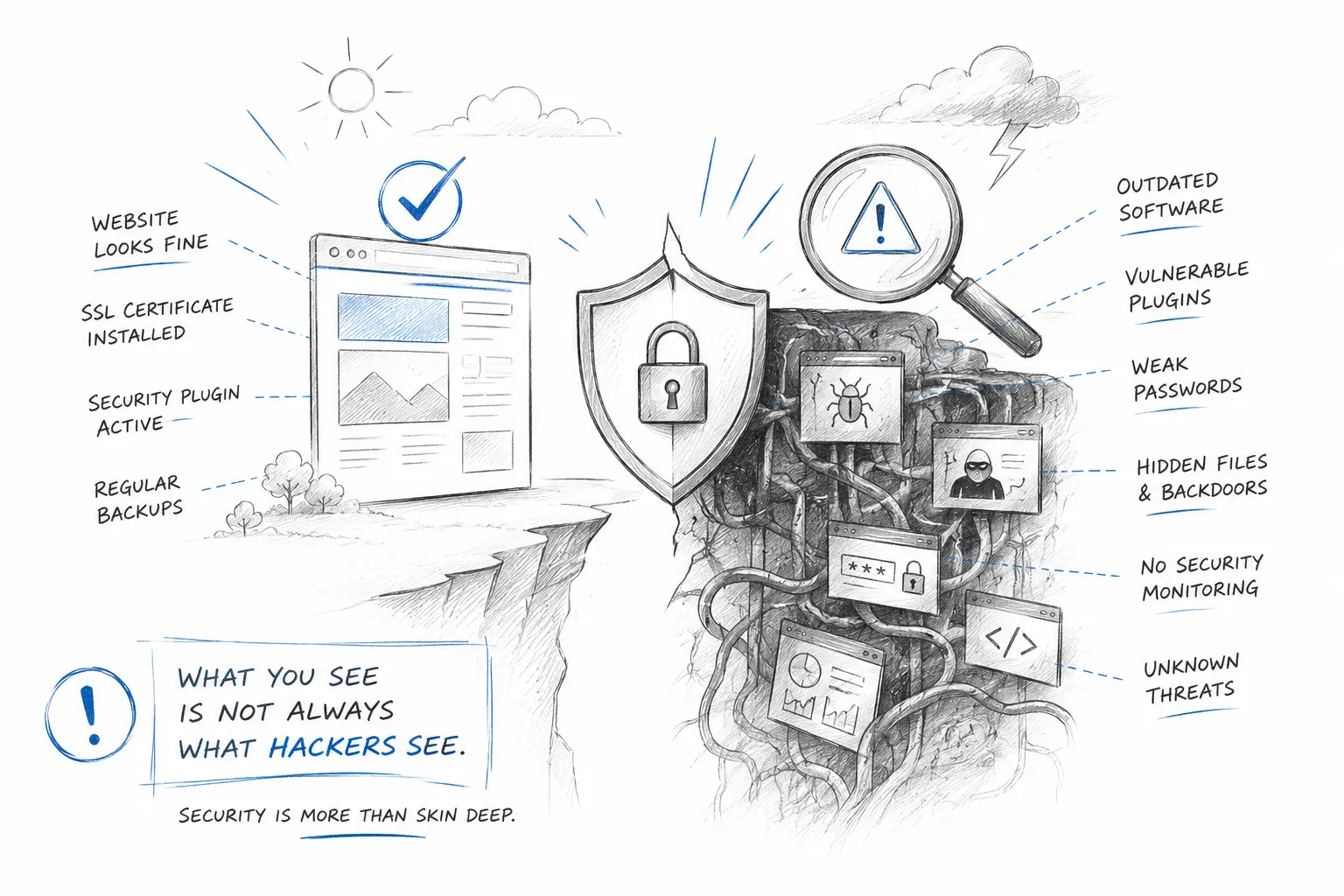
The Most Fatal Security Misconception for SMEs
With the rapid advancement of Artificial Intelligence (AI), technology is boosting operational efficiency for businesses while quietly triggering a cybersecurity storm. Today’s cybercriminals no longer rely on manual intrusion; instead, they deploy AI-automated tools to scan the web for vulnerabilities 24/7. In the face of these intelligent attacks, traditional static defense mechanisms are facing unprecedented challenges.
In Malaysia, many small and medium-sized enterprises (SMEs) harbor a common misconception about website security. The most frequent refrains are: “We’re just a small business. Our website doesn’t have high traffic or recognition, and cybercriminals won’t get any money from hacking us anyway.”
However, this blind neglect of security is often the starting point of catastrophic business losses.
For a simple corporate website with only 5 to 10 pages, there appears to be no confidential data at first glance. Many business owners even naively assume: “Even if the website gets compromised, can’t we just restore it with a backup?”
But modern cybercriminals have long since changed the rules of the game. They rarely attempt to steal money directly from SME websites that lack transactional cash flow. Instead, they use these poorly defended sites as “zombie machines” (botnets) and stepping stones. Cybercriminals secretly inject illegal gambling or adult content deep into hidden server directories, or perform SEO Spam injections—quietly exploiting your domain name to generate massive profits for themselves.
It is only when businesses receive a violation warning from their hosting provider, or even a formal notice from enforcement agencies, that they suddenly realize: their official website has been completely hijacked by cybercriminals and blacklisted by major search engines.
The price of this “hindsight” is devastatingly high:
- Domain Ruined: The domain name you worked years to build gets blocked by web browsers and flagged as a “Dangerous Site.”
- Physical Assets Rendered Useless: QR codes and printed URLs on product packaging, business cards, brochures, and flyers instantly become “dead links.”
- Digital Assets Wiped Out: Online ad campaigns fail, and your Google search indexing and SEO rankings vanish overnight.
- Brand Trust Bankrupted: Prospective clients are greeted with alarming security warnings the moment they visit your site, causing corporate reputation to crumble instantly.
When hearing “website security,” many business owners immediately imagine astronomical professional service fees. In reality, security protection isn’t better just because it’s more expensive; tailored solutions are the truly prudent approach.
To put it into perspective, SMEs do not need to build expensive “national-level” or “bank-grade” defense lines. Based on my own experience and perspective:
- 80% of Common Security Threats: Can be easily kept at bay through routine maintenance, system/plugin updates, and vulnerability audits.
- The Remaining 20% of Unknown Risks: Can be effectively safeguarded in real time with a reasonable Web Application Firewall (WAF).
Cybersecurity is not an exclusive privilege reserved for enterprise giants—it is the baseline for every digitalized business. Don’t let a single oversight destroy the brand reputation you have spent years building.
Learn More: How can SMEs build an 80/20 website protection shield at low cost?