
Using AI as a selling point has become a badge of honour for businesses across every industry. Slap “AI” onto anything and suddenly it sounds more compelling which, from a sales and marketing perspective, actually works.
AI CCTV. AI tyre workshops. AI health screenings. The list goes on. You name it, AI has touched it. Sound familiar? This is exactly what happened when the internet first emerged every business scrambled to be “online,” whether it made sense or not.
Most small businesses use generative AI tools to write emails, craft copy, and generate images essentially glorified admin assistance. Companies with a bit more IT awareness deploy AI chatbots as customer service agents. Those with larger budgets build their own private AI agents.
But does every product, service, or system actually need AI built into it?
Here’s a real case. A wholesale client of mine was receiving hundreds of WhatsApp messages every day all asking the same thing: “What’s the current price for this product?” His instinct was to solve this with an AI customer service chatbot that could automatically handle pricing enquiries, reducing his dependency on headcount. Staff training, human pricing errors, sick leave all of these are real costs.
After a deep-dive conversation with him, I analysed the situation and advised him that AI was not the right tool for this particular problem. Here’s why:
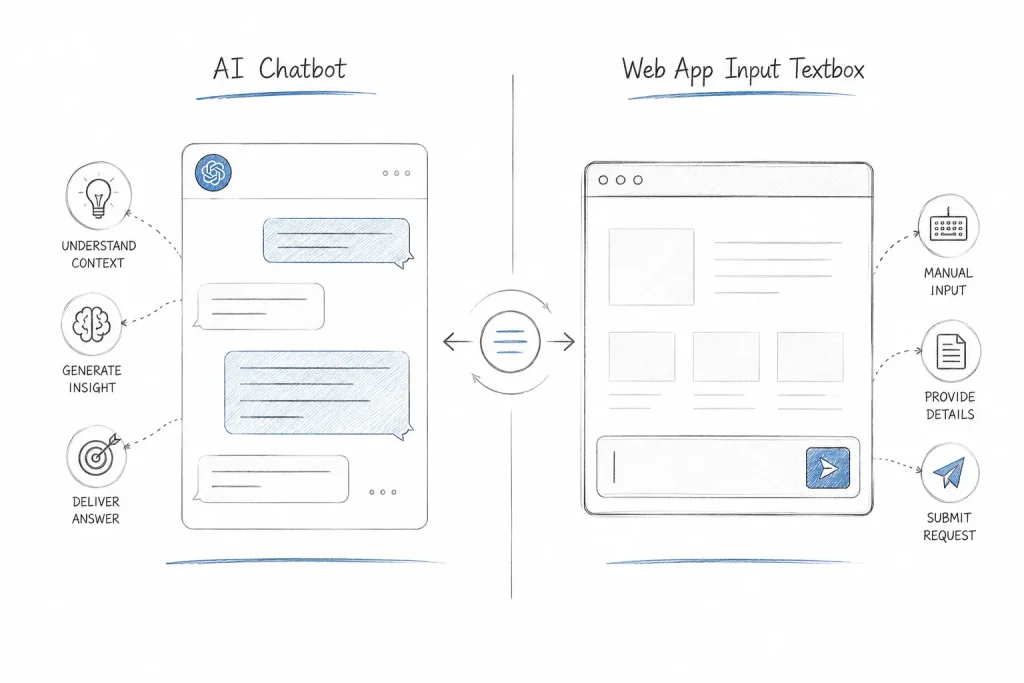
1. A simple web app would solve this faster and more accurately.
A product price lookup page where a customer enters a product name or code and instantly gets the price would do the job completely. No back-and-forth. No conversation. Just an answer.
Compare that to how an AI chatbot interaction actually plays out:
AI Chatbot: Hi, how can I help you?
Customer: Hi, I'd like to check a product price.
AI Chatbot: Could you describe the product in more detail?
Customer: It's for my machine...
AI Chatbot: What type of machine is it?
The problem is clear: AI chatbots are designed to be conversational and human-like which means they can’t give you a direct answer without first gathering context. A web app with a single input field and a simple instruction “Enter product name or product code” is faster, cleaner, and far less frustrating for the user.
2. AI chatbots require ongoing training and quality control.
Deploying a chatbot isn’t a one-time setup. It requires continuous data input, output monitoring, and quality refinement not unlike onboarding a new employee, except you’re doing it indefinitely. Yes, AI makes fewer errors than humans. But the maintenance overhead is real.
A web app, on the other hand, simply pulls from a product database using pattern matching. Accurate. Predictable. Done.
3. AI chatbots come with hidden costs.
Not intentionally hidden but genuinely difficult to estimate. AI output is billed by tokens, and you cannot control how many questions a user asks, how they phrase them, or how long each conversation runs. Every user has their own way of expressing themselves.
A web app, by contrast, constrains the interaction by design. Fixed input. Fixed output. Fixed cost.
The point isn’t that AI is flawed. The point is that when we architect AI solutions, the intended use case must be crystal clear. AI should not be adopted as a trend. It should be deployed as a tool specifically for tasks that are repetitive, logic-driven, and genuinely beyond what simpler systems can handle.
The real question to ask before any AI investment isn’t “Can we use AI for this?”
It’s “Should we?”
If you’re evaluating whether AI is the right fit for your business operations, the answer usually starts with understanding your workflow first not your technology options. Get in touch with Entertop to discuss.