Tag: SEO

  • Navigating Future SEO and AI

    Navigating Future SEO and AI

    Overview: The New SEO Reality

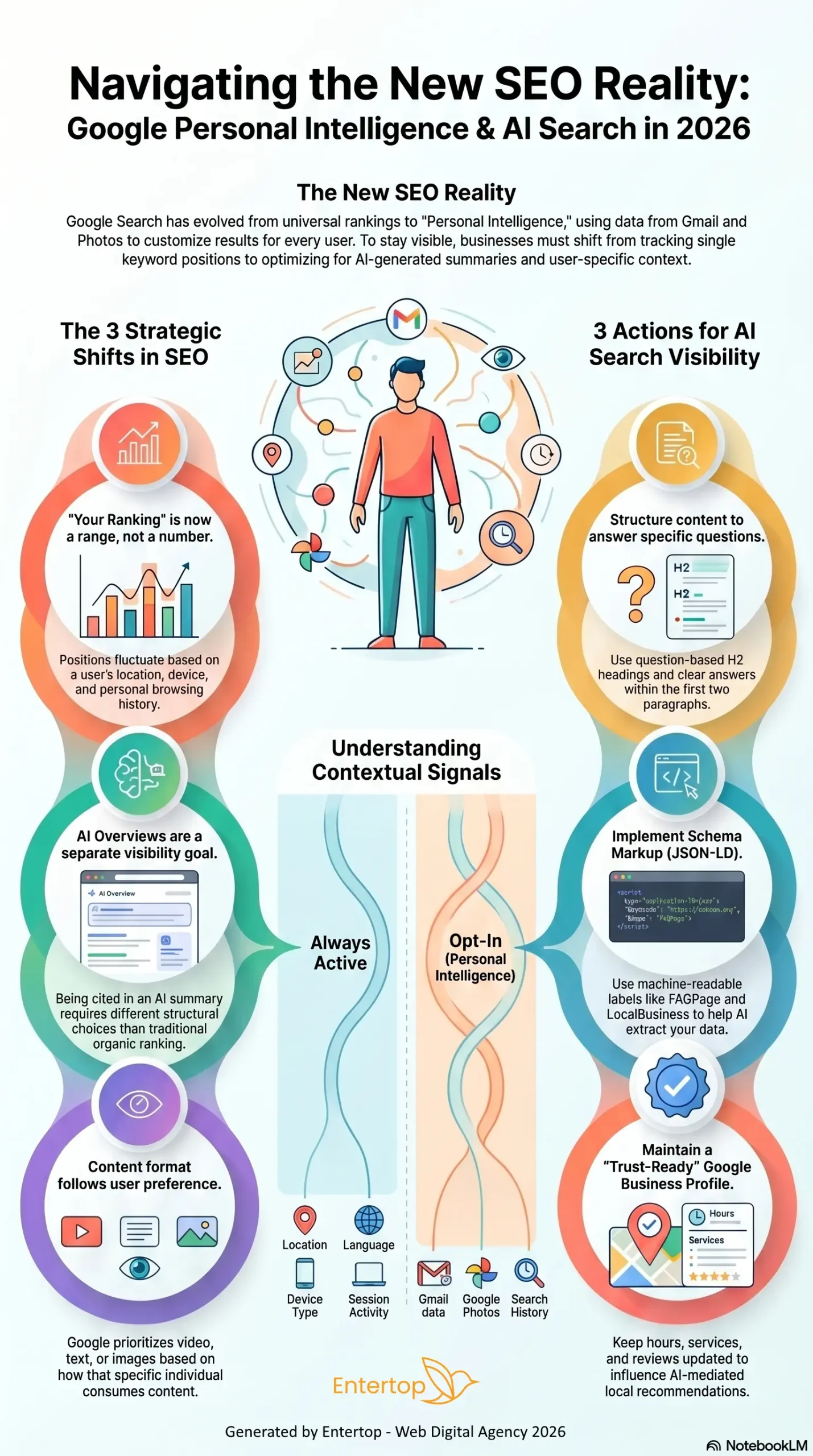
    The infographic highlights a shift from universal, static keyword rankings to “Personal Intelligence.” Google now leverages highly individualized user data—such as Gmail, Photos, and Search history—to customize results. To remain visible, businesses must shift away from tracking single keyword positions and focus instead on optimizing for AI-generated summaries and user-specific contexts.

    The 3 Strategic Shifts in SEO

    Traditional SEO metrics are evolving into dynamic, user-centric goals:

    1. “Your Ranking” is a Range, Not a Number: Positions fluctuate dynamically based on a user’s location, device type, and personal browsing history.
    2. AI Overviews are a Separate Visibility Goal: Securing a citation in an AI summary requires fundamentally different structural and content choices than traditional organic ranking.
    3. Content Format Follows User Preference: Google dynamically prioritizes video, text, or image-based results depending on how a specific individual naturally prefers to consume content.

    Understanding Contextual Signals

    The graphic divides the signals Google uses into two distinct categories:

    • Always Active: Fundamental contextual data including Location, Language, Device Type, and Session Activity.
    • Opt-In (Personal Intelligence): Deeply personal user data that shapes the algorithm, including Gmail data, Google Photos, and Search History.

    3 Actions for AI Search Visibility

    To adapt to this new AI-driven landscape, the infographic recommends three concrete optimization strategies:

    • Structure Content for Specific Questions: Use question-based H2 headings and ensure clear, direct answers are placed within the first two paragraphs.
    • Implement Schema Markup (JSON-LD): Use machine-readable code labels (like FAQPage and LocalBusiness) to make it easier for AI algorithms to extract and understand your data.
    • Maintain a “Trust-Ready” Google Business Profile: Keep hours, services, and reviews meticulously updated to positively influence AI-mediated local recommendations.

    Source Note: This infographic was generated by Entertop – Web Digital Agency.

    Source: https://www.seowebmalaysia.com

  • The SEO Report I Should Have Written Differently

    The SEO Report I Should Have Written Differently

    Not long ago, a client signed up for our SEO package. The goal was straightforward: get their services found on search engines.

    They were highly focused on measurable outcomes. Before we even started, they asked for a forecast SEO report — a projection of what results to expect after the SEO work was done. How much would impressions grow? What about clicks? How many keywords would rank high? This is standard practice in traditional SEO: let the numbers do the talking, and watch the rankings climb.

    Then Google changed the rules.

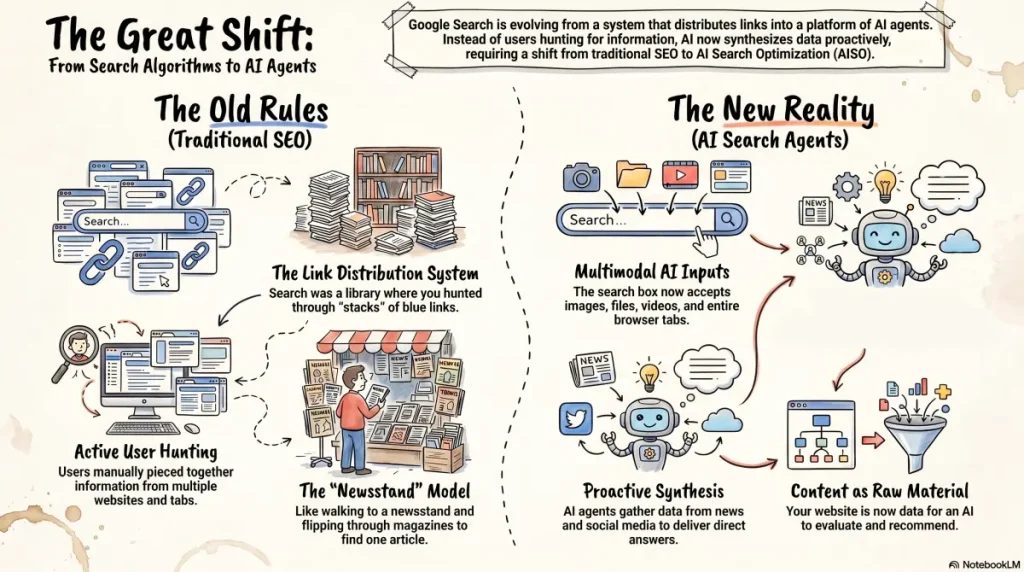
    At I/O 2026 in May, Google made it official — something that had been quietly brewing for over a year: search is no longer primarily a link distribution system. It is becoming an AI agent platform.

    This wasn’t Google adding an AI summary box to the top of search results. This was Google rebuilding Search itself — from a results page into an integrated interface for AI-powered answers, AI agents, and personalised task execution.

    Even the search box has been redesigned. It no longer just accepts keywords. It now supports text, images, files, videos, and even Chrome tabs — a fully multimodal AI-powered input. Users no longer need to search step by step and piece together information on their own. The AI Search Agent proactively synthesises content from blogs, news, social media, and real-time financial and shopping data — and delivers it directly to you.

    Think of it this way: you used to walk to the newsstand, flip through a stack of magazines, and hunt for the article you needed. Now the paperboy drops the exact edition you want at your front door every morning.

    Users have shifted from actively searching to passively receiving.

    So what does this mean for the majority of businesses that rely on SEO to generate enquiries?

    Your website content is no longer just the medium through which users find you. It is now the raw material that an AI agent evaluates when deciding whether to recommend you.


    Does SEO still matter?

    Yes. But the goal has changed.

    You are no longer optimising purely for Google’s algorithm. You are optimising for the judgement of an AI Agent — how it reads, interprets, and decides whether your content is worth surfacing.

    This is why SEO combined with AI Search Optimization is not an optional upgrade for your online marketing strategy. It is the next mandatory foundation.

    As for that client who asked for a forecast SEO report — I should have handed it to them with a note on the first page:

    “The projections in this report reflect performance under the old rules. The game has changed. Let’s redefine what success looks like — together.”